
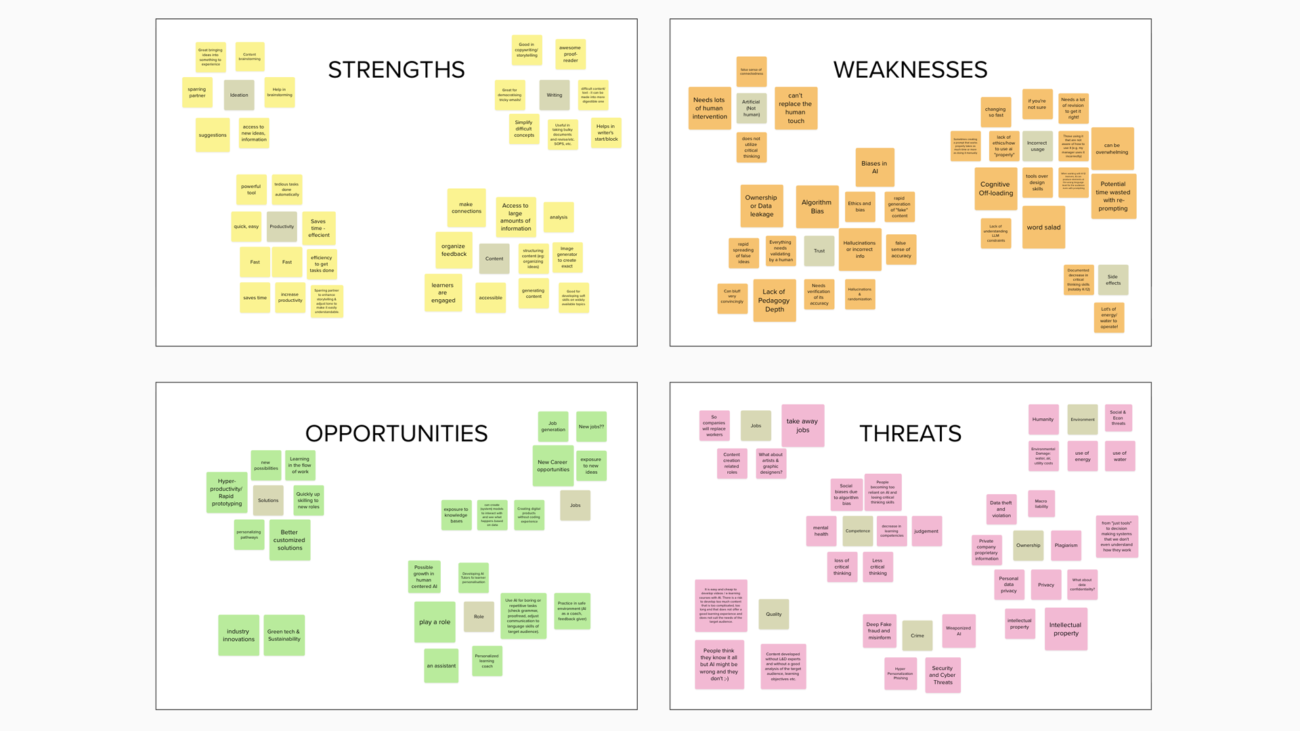
Is artificial intelligence (AI) a strength, opportunity, weakness or threat for learning experience design (LXD)? We gathered forty learning experience designers to do a SWOT analysis of AI for LXD.
A SWOT analysis is used to evaluate the strategic position of organisations or projects. During a recent LXD meet-up, we used this concept to analyse the position of LXD, as a field, amidst the rapid development and noticeable impact of AI on how we design learning experiences. For each of the strengths, weaknesses, threats and opportunities we’ve identified the major theme’s that are relevant to LXD today.
Strengths
Productivity: Increasing productivity by working more efficient when using AI can save time and money. Automating tedious tasks makes work more enjoyable and free up time for more interesting work, like engaging with learners through design research.
Content: Generating, structuring and analysing content becomes easier with AI. Creating images, text, audio, video and animation has become much more accessible and easier to do. As a designer, you are the director of the creative process and AI assists you in generating the content you envision.
Writing: If you are struggling with writer’s block, AI can get things moving. It can also help to simplify complex subjects and assist you in writing text that is easy to digest. Proof reading, translating and rewriting your text to suit different type of learners is also a big strength.
Ideation: Having AI as a sparring partner during brainstorming can lead to generating more and sometimes better ideas, especially if you’re working alone. AI can provide a different perspective as you generate and assess new ideas for your design. It can prevent personal bias that sneaks into our ideas. At the same time, by speeding up the ideation process, you’ve got more time left for developing your best ideas.
Weaknesses
Trust: Can you trust what AI tells you? That’s a key weakness as AI can bluff convincingly and hallucinations can lead to incorrect data and misinformation. Anything you generate with AI, needs human validation, which can be challenging if you are not the expert. Trusting the outcome without validation creates a false sense of accuracy.
Artificial: AI is not human, it’s artificial. That’s its strength but also its weakness. LXD is about providing an empathic and personal experience which requires a human touch. This indicates major limitations for using AI in the design process. For example, generating personas using AI undermines the reason to create personas in the first place: to empathise with the learner and gain a deep understanding of who they are and what they need.
Difficulty: Using AI isn’t as easy as it seems. Sometimes creating a prompt that works properly takes as much time or more as doing it manually. Often, the outcome needs loads of revisions and sometimes the outcome is simply not usable and you have to start over. Some people are not even aware of the fact that they are using AI incorrectly, leading to bad decisions. As AI develops rapidly, it can be overwhelming for learning experience designers to keep up and make the right choices.
Opportunities
Role: AI can play different roles in the design process but also in the actual learning experience. It can be an assistant for the designer and for the learners. It can be used for role playing exercises. It can be a tutor or coach assisting the learner. Figuring out which role(s) AI can play for your learners can boost engagement and provide meaningful interaction.
Solutions: Using AI to find better solutions is a big opportunity. For example, a more personalised learning path and improved customisation can provide a better learning experience. Finding the right solution becomes easier by rapidly prototyping your designs and frequent user testing.
Jobs: AI isn’t all bad news for employment. It can expand your toolbox, making your skillset more desirable for clients. For example, if you can develop digital learning experiences without the need for coding expertise, it gets easier to provide a one stop shop solution for your clients. Also, new roles can emerge from integrating AI with LXD, leading to new career opportunities.
Threats
Ownership: Who owns AI generated content? You, the AI platform or the people who created the work on which the AI platform is trained? That’s unclear right now. Copyright and intellectual property are out of the window as books, articles, illustrations, photography and artwork are fed to AI platforms without consent by or compensation for the creators. This makes ownership unclear when it comes to anything you generate with AI.
Privacy: Designing a learning experience with AI on a sensitive topic, like security measures in a large organisation, can be a problem. For example, you can’t ask AI platforms to rewrite or summarise text with sensitive information. Most platforms keep your data to train the system but they can also sell it. You don’t want to be responsible for getting that data sold, it can cost you dearly. Besides that, privacy is under threat in many situations where AI is involved. Just think about how AI note taking or virtual assistants like Siri or Alexa are always listening in to everything you say.
Competence: There’s a risk of loosing skills if we lean too much on AI. As a result, we can become less competent and it becomes harder to assess and increase the quality of our work. For example, being able to generate ideas as a designer is key. If you need AI tools to generate ideas because you can’t, are you even a designer? As new learning experience designers enter the workforce, they may not be competent in key areas of LXD due to heavy reliance on AI tools. This could threaten the future of LXD as a field.
Jobs: If clients are willing to settle for run of the mill AI generated learning experiences, why would they pay you for a unique design? The added value learning experience designers offer, needs to be articulated clearly to be noticed and appreciated in order to remain successful. So, unless you’re able to stand out in a see of mediocrity, you will be in trouble.
Conclusion
It’s clear that there are many upsides and downsides to using AI in LXD. During the SWOT analysis, the category that got the most input, was “threats.” Apparently, these forty learning experience designers see more threats than opportunities. I decided to leave out environmental impact and crime as they are more general concerns and not specifically related to LXD. At the same time, the strengths of AI can not be denied and all who participated in the analysis use AI themselves.
This is a snapshot of how we perceive things today. I’m sure it will change rapidly and we need to keep adapting. Just as important, we need to be critical of the pro’s and con’s of using AI. Doing a SWOT analysis helps to do that and it will be interesting to repeat the process in a year’s time.
A huge thank you to all participants of the LXD meet-up for creating the SWOT analysis!